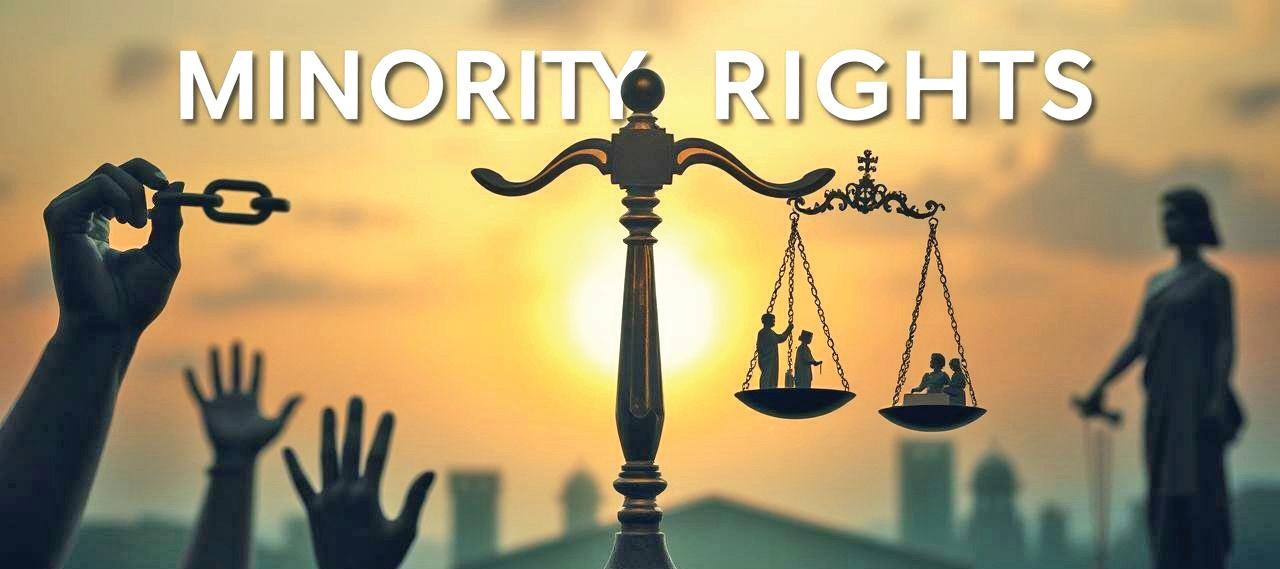
In the early decades of the 21st century, the word 'democracy' has often been reduced to a simple mathematical equation: 50%+1 equals absolute power. Yet, as we navigate the complex geopolitical landscape of 2025, this reductive view is proving to be a dangerous fallacy. The true health of a democracy is not measured by the volume of the majority's roar, but by the quiet confidence and safety of its smallest groups. The 'Minority Concept' is not a modern luxury or a Western imposition; it is the structural cornerstone of any stable civilization. Today, however, that cornerstone is being chipped away by a global resurgence of majoritarian nationalism, digital polarization, and systemic exclusion. To understand why this matters, we must look at the principle of minority protection not as an act of charity, but as an essential safeguard for the human collective.
Identity Beyond the Decimal
In international law, there is no single, universally accepted definition of a 'minority,' but the 1992 UN Declaration provides the standard: they are national, ethnic, religious, or linguistic groups who possess characteristics that differ from the rest of the population and who wish to maintain their unique identity. Crucially, minority status is both an objective fact (numerical weight) and a subjective choice (the desire to preserve a heritage). It is a status that protects the 'distinctiveness' of a human being. In a world of increasing homogenization, the minority concept serves as a legal fortress for human diversity.
The Blueprint for Harmony: Dignity, Equity, and Security
1. The Pillar of Human Dignity
Human rights are predicated on the idea that every individual possesses inherent dignity. This dignity is often tied to one's community. For a Sikh in India, a Baha'i in Iran, or an Indigenous person in the Amazon, their sense of self is inseparable from their faith, language, or ancestral land. When a state suppresses these markers of identity, it does not just commit a legal error; it commits an assault on the human spirit. Protection ensures that the 'right to be different' is as sacred as the 'right to be equal.'
2. The Pillar of Substantive Equality
True equality is not about treating everyone the same; it is about ensuring everyone has the same opportunity. This is the concept of Substantive Equality. If a state provides education only in the majority language, it formally treats everyone 'equally' but effectively handicaps minority children. Protection measures, such as bilingual education or reserved political representation, are necessary to level a playing field that is naturally tilted toward the majority.
3. The Pillar of Global Security
Marginalization is the primary fuel for conflict. History, from the Balkans to Sudan, shows that when a minority is pushed to the periphery—denied a voice, a job, or a home—the social contract dissolves. The protection of minorities is, therefore, the world's most effective conflict-prevention tool. A state that includes its minorities is a state that remains stable; a state that excludes them invites its own fragmentation.
The Global Erosion: Mapping the Crisis of Minorities in 2025
Despite these clear principles, the 2025 landscape for minority communities is increasingly grim. We are witnessing a 'normalization of exclusion' across several fronts.
- Europe and the Americas: In established Western democracies, the tide is turning. Across the European Union, far-right parties have gained significant ground by weaponizing anti-immigrant and anti-minority rhetoric. The Roma community remains the most structurally excluded group in Europe, facing barriers to housing and education that have persisted for decades. In the United States, the struggle for racial equity continues against a backdrop of legislative attempts to roll back voting rights and diversity initiatives. In Latin America, Indigenous minorities are facing a 'new colonization' as extractive industries (mining and logging) encroach on ancestral lands with the tacit support of governments in search of economic growth.
- The Middle East & Africa: The situation in Sudan and Gaza represents the most extreme end of the spectrum. In Sudan, the Rapid Support Forces (RSF) have been accused of ethnic cleansing campaigns in West Darfur, targeting Masalit and other non-Arab communities. Meanwhile, in Gaza, the civilian population faces a humanitarian catastrophe that the UN warns could amount to the crime of genocide, with minority and vulnerable groups bearing the brunt of the infrastructure collapse. In Iran, the Baha'i community remains the target of 'cradle-to-grave' persecution, denied access to higher education and subjected to arbitrary detentions simply for the practice of their faith.
- Asia: In China, the 'relentless campaign of repression' continues in Xinjiang and Tibet. The state's drive for 'national unity' has manifested as a systematic erasure of independent cultural and religious identities, often under the guise of national security. In India, the world's largest democracy, international observers including the UN and Human Rights Watch have raised alarms over the 'legalized marginalization' of religious minorities. The implementation of the Citizenship Amendment Act (CAA) and the rise of state-level anti-conversion laws have created an environment where Muslims, Christians, and Sikhs report increasing systemic discrimination and derogatory rhetoric from public officials.
The Disinformation Trap
A unique horror of 2025 is the role of Generative AI and social media in minority persecution. Minority communities are no longer just being attacked by laws; they are being attacked by algorithms. Sponsored troll farms and automated bots are used to spread disinformation, making minorities the scapegoats for economic hardships or social unrest. Once a lie is digitized and scaled, it becomes a justification for real-world violence.
Securing Tomorrow: Beyond Borders and Bias
The protection of minorities is the ultimate 'insurance policy' for humanity. In a world of shifting borders and changing demographics, we are all potentially a minority in some context—whether by our faith, our politics, our language, or our birthplace. If we allow the concept of minority rights to be discarded in favor of pure majoritarianism, we are essentially saying that might makes right. We are returning to a world where the law of the jungle replaces the law of the state. As we move forward toward 2026, international voices and global citizens alike must champion decisive partnership, ensuring every group has the authority to shape their own destiny. Protecting minorities means ensuring they have a seat at the table where the laws are made. It means recognizing that a country's greatness is not found in its homogeneity, but in its ability to weave a thousand different threads into a single, resilient fabric. The defense of the minority is, in its truest sense, the defense of democracy itself.
Sudhir S. Raval is Consulting Editor at the ITV Network
