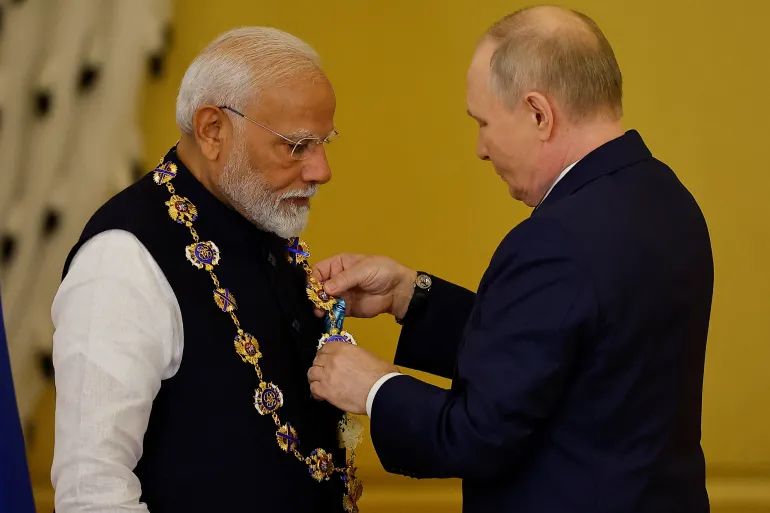
Russian President Vladimir Putin's recent visit to India, which was primarily associated with the 23rd India-Russia Annual Summit, was exceedingly important and challenging for India in the current global scenario. The meeting with Indian Prime Minister Narendra Modi was crucial not only for the bilateral relations between India and Russia but also in the context of India's reciprocal bilateral, trilateral, and quadrilateral relationships with three major powers: the United States, Russia, and China. In short, the outcome of this visit can be described as India's foreign policy displaying its true mettle at a right time. Its significance is manifold, especially since India’s restraint and soft approach in foreign policy matters were being tested against the backdrop of President Donald Trump’s changed attitude towards India, his use of threatening language, whimsical policies, and overt attempts at pressure.
Bilateral Cooperation Across Key Sectors:
Typically, the evaluation of a meeting between the heads of two nations is centered around the agreements signed between them. This time, no major agreements were signed between India and Russia, but in the changing global geopolitical landscape, this visit has proven to be very important for the economic and security interests of both countries. The agreements between the two nations encompass crucial areas related to both countries' needs: defense and strategic cooperation, trade targets, energy security and nuclear cooperation, and mutual people-to-people cooperation.
The production of modern weapons in India will increase India's self-reliance in the defense sector, while for Russia, it ensures the continued regular export of its defense industry products to a vast market like India. Economically, both countries have set a target to increase trade to $100 billion by the year 2030. For India, this offers export benefits, especially in the pharmaceuticals, automobiles, and agricultural product sectors, and the advantage of fast-tracking a Free Trade Agreement with the Eurasian Economic Union. For Russia, India's rapidly developing economy provides it with a stable and strong customer for energy, fertilizers, and other raw materials. Both countries have emphasized increasing trade in their local currencies, the Rupee and the Ruble, which will help reduce global Dollar pressure. In the energy sector agreement, India benefits from Russia's assurance to remain a reliable supplier of crude oil, gas, and coal, which is important for India's energy security. Furthermore, the possibilities for accelerating the Kudankulam nuclear power projects and cooperating in new areas like Small Modular Reactors have increased. Russia's benefit is that, even amidst the sanctions imposed by Western countries, having a large customer like India provides economic stability to its energy industry.
The agreement on people-to-people cooperation is as necessary for India as it is for Russia. Agreements on labor activity and migration will provide new employment opportunities for skilled Indian workers in Russia. The availability of a 30-day free e-visa for Indian tourists will boost tourism and cultural exchange. Conversely, Russia will benefit from utilizing India's young and skilled human resources for its development.
India's Policy of Strategic Equidistance:
It is a fact that this visit by the Russian President on home ground was a test for India to sustain its strategic interests and maintain a balance in its relationships with two major powers: Russia and the US. India's foreign policy has believed in a multi-polar world since the time of the first Prime Minister, Jawaharlal Nehru. India wishes to maintain close relations with every country based on its national interests, rather than joining a single bloc.
Russia has been India's largest supplier of defense equipment for decades. The S-400 missile system and Sukhoi aircraft are examples of this. Its cooperation has also continued in the energy, space, and nuclear energy sectors. Although this situation began to change rapidly after 2022, through this visit by Putin, India honored its long-standing relationship and maintained its foundation for defense and energy-related needs. Similarly, concerning the US, India today shares a rapidly growing strategic partnership with the US, especially in QUAD and the Indo-Pacific region. The US has become India's main trade and technology partner.
Washington's Strategic Tightrope:
In some American circles, India's decision to continue with Putin's visit and the delivery of the S-400 has been viewed as a negative signal. Under the American law CAATSA (Countering America’s Adversaries Through Sanctions Act), it can impose sanctions on India for making large defense deals with Russia. However, no official statement has been made yet. Moreover, after Russia's invasion of Ukraine, the US increased diplomatic pressure on India to reduce its energy and defense purchases from Russia, but by not succumbing to such pressure, India has sent a clear message to the US and the world that India makes decisions about its defense needs and strategic partners independently and will never do so under pressure from any other country.
India has also demonstrated that despite its close ties with the US, it will not sacrifice its relationship with its long-time friend, Russia. This stance by India helps preserve its strategic autonomy.
The US also knows that India is an indispensable partner for it in the Indo-Pacific region to counter China. Therefore, it cannot completely spoil its relationship with India due to India's ties with Russia. In this situation, the US has not made any clarification regarding a CAATSA waiver for India on the S-400 issue, but the restraint it has maintained so far shows that the US cannot afford to damage its relations with India by issuing reckless threats.
Trilateral Relations with China:
Viewing this India-Russia meeting in the context of India's relations with China is a complex example of trilateral strategic relations. Putin's visit has proven important amidst the ongoing military standoff and tense relations between India and China along the LAC (Line of Actual Control). Through Putin's successful visit, India sent a clear message to China that even if India is strengthening relations with QUAD and the US, it is also capable of maintaining its ties with its tried and tested friend, Russia, for strategic interests.
In recent years, especially after the Ukraine conflict, the economic, strategic, and diplomatic closeness between Russia and China has increased significantly. Both countries strongly support each other to balance the global influence of the US. Russia, which once acted as India's main defense supplier against China, has now also become an important partner for China. This has added a new dimension to India's strategic planning.
The most important issue in this context is trilateral cooperation. Russia, India, and China all three countries work together informally under the RIC format and on platforms like the SCO (Shanghai Cooperation Organization). Besides this, both countries are also involved in BRICS. Putin's visit has encouraged the RIC framework, which demonstrates that these three powers are ready to cooperate globally with each other, even if their bilateral relations (India-China) are strained. One point is that Russia supports India for permanent membership in the UN Security Council (UNSC), and Russia can be an important link in gaining China's acceptance on this.
Yes, a matter of concern for India is that while Russia sells modern weapons to India, it also provides cutting-edge weapons and technology to China. Strategically, this duality is a matter of worry for Indian security establishments. As the China-Russia friendship deepens, Russia has avoided openly taking India's side in the LAC dispute and has adopted a neutral stance, which is also a point for consideration. Russia's increasing closeness with China is also going to remain a permanent challenge in India's strategic planning. Nevertheless, through the outcome of Putin's visit, India has given a clear signal to China that India is not isolated.
The Final Verdict: Autonomy Confirmed
Overall, it can be said that India and Russia have given the world a broad message of their unbroken strategic friendship, and in that sense, Vladimir Putin's visit to India can be seen as an excellent example of India's independent and balanced foreign policy.
Sudhir S. Raval is Consulting Editor at the ITV Network
