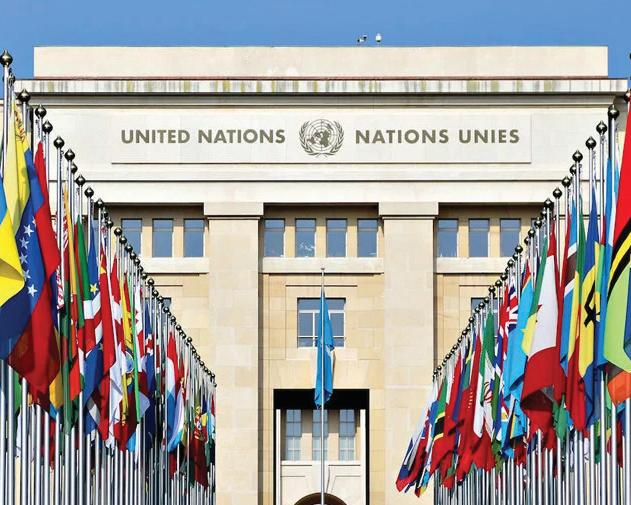
The United Nations was conceived in 1945 as a grand moral firewall—a sacred vow to shield humanity from the recurring fires of global conflict. Yet, in 2026, that firewall is crumbling under the weight of systemic paralysis and a 20th-century blueprint that has failed to adapt to a 21st-century reality. From the 'Veto Trap' that holds collective security hostage to a 'Sovereignty Shield' that often protects the perpetrator over the victim, the UN is facing an unprecedented crisis of legitimacy. To understand its current faltering is not merely to critique a bureaucracy, but to witness a profound betrayal of the 'Never Again' promise. If the 'Glass Palace' on the East River is to remain relevant, it must undergo a fundamental metamorphosis—moving beyond the politics of national vanity to finally become the true conscience of humanity. This is the story of how we lost that mandate, and the radical roadmap required to reclaim it.
The United Nations was baptized in the shadows of the Holocaust and the ruins of Nagasaki, founded on a sacred, singular vow: that the world would never again stand silent while humanity was systematically erased. It was envisioned as more than a diplomatic forum; it was meant to be the world’s ultimate moral firewall. Yet, in the eighty years since, that firewall has repeatedly collapsed under the weight of national self-interest and structural apathy. As we stand in 2026, the UN finds itself caught in a precarious ‘legitimacy trap’—tasked with solving 21st-century existential threats using a 20th-century blueprint that remains stubbornly frozen in time. To understand why the UN is currently faltering is not merely to critique a bureaucracy, but to diagnose a systemic paralysis that threatens the very fabric of our global order.
The Veto Trap: The Architecture of Paralysis
The primary engine of the UN’s failure is its foundational blueprint. The ‘Veto Power’ granted to the five permanent members (P5) of the Security Council was a 1945 pragmatic compromise to keep the world’s heavyweights at the table. In 2026, this compromise has become a cage.
When the UN was formed, the veto was intended to prevent major power conflict. Instead, it has been weaponized to shield aggressors and paralyze humanitarian intervention. Whether it is the blocking of resolutions regarding the invasion of Ukraine or halting ceasefires in the Middle East, the veto allows a single nation to hold the collective security of eight billion people hostage. When the ‘Fire Department’ of the world is staffed by the very actors lighting the fires, the building will inevitably burn.
The Enforcement Gap: When 'Never Again' Becomes 'Once Again'
The UN’s most profound failure is the chasm between its lofty rhetoric and its inability to stop a bullet in real-time. The ‘Blue Helmets’ were designed to be a shield, yet history is littered with the ghosts of those they were mandated to protect—from the 1994 genocide in Rwanda to the Srebrenica massacre.
In the present global scenario, this gap has widened. The UN’s peacekeeping model relies on ‘consent of the parties’—a diplomatic politeness that is absurd when one of those parties is the perpetrator of atrocities. Furthermore, the UN lacks a permanent, rapid-response force, relying instead on ‘voluntary’ contributions from member states. When the protection of humanity is treated as a voluntary contribution rather than a mandatory obligation, the UN ceases to be a guardian and becomes a mere bookkeeper of tragedy.
The Sovereignty Shield vs. Universal Welfare
The UN Charter is built on the bedrock of ‘sovereign equality,’ yet it also pledges to protect universal human rights. This creates a systemic contradiction. When a state turns against its own people, the UN often hides behind the shield of ‘non-interference.’
This ‘Geopolitics of Compassion’ means that intervention often depends on whether the victims reside in a region of strategic interest to the P5. We see this in the global refugee crisis, now exceeding 120 million displaced souls. While the UNHCR performs heroic logistical feats, the political arm fails to address the root causes—tyranny and civil war—because doing so would infringe upon ‘sovereignty.’ The UN treats the symptoms of global suffering but is structurally forbidden from curing the disease.
Economic Inequity and the Failed Trade Framework
Beyond the battlefield, the UN has failed to regulate a global capitalist system that prioritizes profit over people. While the UN oversees various trade and development bodies, it has struggled to bridge the North-South divide.
The current international trade framework remains skewed, leaving developing nations trapped in cycles of debt and commodity dependence. The UN’s failure to advocate for a more equitable ‘Faith Economy’ or a moral approach to international trade has allowed wealth to concentrate in the hands of a few while the many face austerity. If the UN cannot ensure economic dignity, it cannot expect political stability. Peace, after all, is not merely the absence of war; it is the presence of the means to live.
A 1945 Model in a 2026 Reality
The world of 2026 is unrecognizable from the world of 1945. The rise of the Global South, the economic dominance of nations like India, and the emergence of non-state actors find no formal place in the UN’s elite tiers.
The Security Council remains a ‘Gentlemen’s Club’ reflecting a defunct colonial-era hierarchy. This lack of representation has led to a ‘legitimacy deficit.’ If billions of people across Africa, Latin America, and Asia do not have a permanent seat at the table, the institution loses its claim to speak for ‘We the Peoples.’ This exclusion isn't just an administrative oversight; it is an active suppression of the global majority's voice.
Reclaiming the Mandate: A Roadmap for Metamorphosis
Can the UN’s motives be achieved today? Yes, but it requires a fundamental restructuring. Membership must be expanded to include nations from the Global South, such as India, as permanent members. In cases of documented mass atrocities, the veto should be automatically suspended under the ‘Responsibility to Protect’ (R2P) framework. Furthermore, the UN must shift its developmental focus from raw GDP to a ‘Happiness Index,’ prioritizing mental well-being, social trust, and environmental health as the true markers of a successful nation. Diplomacy must move beyond transactional politics toward a model that integrates moral and civilizational values into global governance.
The Necessity of the Impossible
The United Nations is frequently criticized for being a ‘Glass Palace’ of talk and no action. Dag Hammarskjöld, the UN's second Secretary-General, famously noted that the UN was not created to take humanity to heaven, but to save it from hell.
In 2026, the fires of that ‘hell’ are burning brighter than ever—fueled by climate change, inequality, and unchecked conflict. The failure of the UN is not a failure of its ideals, but a failure of its members to prioritize collective survival over national vanity. To achieve its motives, the UN must stop looking inward at its own bureaucracy and start looking outward at the humanity it was meant to serve. The world does not need a new UN; it needs a UN that finally has the courage to be the conscience of humanity.
Sudhir S. Raval is Consulting Editor at the ITV Network
