In a nation that prides itself on being the ‘Mother of Democracy,’ India is fast approaching a constitutional crossroads where the rewards of progress have become a penalty for political power. As the 2026 deadline for redrawing electoral boundaries looms, a silent but seismic rift is opening between the surging populations of the North and the developmental success stories of the South. We are entering the era of the Great Indian Delimitation Paradox: a high-stakes dilemma where states that successfully embraced education and family planning now face the prospect of being ‘punished’ with diminished representation in Parliament. Can a 21st-century superpower expand its democratic footprint without disenfranchising its most efficient citizens, or will the simple arithmetic of a population explosion fracture the very foundation of Indian federalism?
For over five decades, India’s democracy has been operating under a self-imposed demographic freeze. In 1976, during a period of intense political upheaval, the Indian government suspended the redrawing of electoral boundaries to ensure that states implementing family planning programs were not ‘punished’ with a loss of political representation. That freeze, extended in 2001, is set to expire after 2026.
As India prepares for the first census of this decade, the nation faces a ‘Delimitation Paradox.’ If the Lok Sabha is redrawn based purely on current population data, the ‘Hindi Heartland’ of the North will see a massive surge in seats, while the economically prosperous and socially progressive Southern states will see their relative political influence evaporate. This is not merely a bureaucratic adjustment; it is a fundamental challenge to the federal contract that holds the world’s most populous nation together.
The North-South Divide: A Success Penalty?
The crux of the delimitation crisis lies in a stark divergence in human development. Since the 1971 census—the current benchmark for seat allocation—the Southern states like Tamil Nadu, Kerala, Karnataka, Andhra Pradesh, and Telangana have made remarkable strides in education, healthcare, and birth control.
• Demographic Achievement: Most Southern states have achieved a Total Fertility Rate (TFR) well below the replacement level of 2.1. In contrast, Northern states like Uttar Pradesh and Bihar continue to see high population growth due to lower literacy rates and slower socio-economic transitions.
• The Literacy Gap: Education in the South has empowered women and stabilized populations. However, under a strict population-based delimitation, these achievements become a political liability.
• The Representation Gap: Current projections suggest that if the Lok Sabha expands to accommodate the current population, Uttar Pradesh could gain dozens of seats, while states like Kerala might actually lose seats in absolute terms or remain stagnant while others grow, effectively muting their voice in national policy.
Political Motives and the ‘Hindi Heartland’ Hegemony
The debate is inextricably linked to the current political landscape. The ruling Bharatiya Janata Party finds its strongest mandate in the North and West. Southern regional parties argue that the push for delimitation is a strategic move to cement a ‘majoritarian’ rule where the Hindi-speaking belt can dictate national policy without the need for consensus from the South.
This ‘tyranny of the majority’ creates a friction point in fiscal federalism. The South contributes a disproportionately high share to the national GDP and tax pool. There is a growing sentiment that the South is ‘subsidizing the North’—paying for the infrastructure and welfare of populous Northern states while simultaneously losing the political power to influence how those funds are distributed.
Constitutional Requirements vs. Democratic Equity
The Indian Constitution, through Article 81, mandates that the ratio between the number of seats and the population of a state should be the same across all states. However, the 42nd and 84th Amendments were pragmatic interventions to prevent a race to the bottom in population growth.
The legal question now is whether ‘one citizen, one vote’ should trump ‘one state, one voice.’ If representation is purely based on the number of heads, then the Southern states are being penalized for their efficiency and contribution to national goals like population stabilization. If representation is frozen indefinitely, the North is under-represented, with some MPs representing over 3 million people—a logistical impossibility for effective governance.
Beyond 75 Years: Why India Must Increase its Seats
As India marks over 75 years of independence, the current Parliament size of 543 is an artifact of a bygone era. In 1971, an MP represented roughly 1 million people; today, that figure is closer to 2.5 million. An MP cannot effectively oversee development projects or address individual grievances for 3 million constituents. A larger pool of representatives allows for more specialized committee work and a broader range of voices in the national discourse. Compared to other large democracies, India’s representative-to-citizen ratio is one of the highest in the world. Expanding the house is a functional necessity for a modern, 21st-century state.
The Global Roadmap: Lessons in Federal Balance
To solve this, India does not need to reinvent the wheel. Several global models offer a way to increase representation without triggering a North-South divorce.
1. The American ‘Great Compromise’
The U.S. solves the population-versus-equity crisis through a perfectly bicameral system. While the House of Representatives is population-based, the Senate gives every state exactly two seats. India could reform the Rajya Sabha to grant more equal or weighted representation to states, regardless of their population, acting as a ‘Federal Veto.’
2. The German ‘Bundesrat’ Brackets
Germany uses a weighted system where states are grouped by population size but given a capped range of votes (e.g., 3 to 6 votes). This prevents the largest state from having an absolute majority on its own. India could move away from a direct linear population-to-seat ratio and move toward a ‘bracketed’ system for the Lok Sabha.
3. The Canadian ‘Grandfather Clause’
Canada guarantees that no province will ever have fewer seats than it had in a previous constitutional milestone. India must implement a ‘No-Loss Guarantee,’ ensuring that no state sees its seat count reduced, even if its population percentage drops.
4. The European Union’s ‘Degressive Proportionality’
The EU gives smaller nations more seats per capita than larger nations. This ensures that a citizen in a small nation still feels their voice can impact the central government.
A New Blueprint: How to Implement the Change
The solution for India must be a multi-tiered constitutional reform rather than a simple mathematical expansion. Increase the Lok Sabha to approximately 848 seats to lower the MP-to-citizen ratio. This acknowledges the North’s population reality. Introduce a formula where 20-30% of seat allocation is based on ‘Developmental Indices’ (literacy, health, and economic contribution) rather than just raw population. Empower the Rajya Sabha. Any bill affecting federal relations or state boundaries should require a ‘weighted majority’ in the Rajya Sabha, ensuring the South has a meaningful check on the North’s numerical dominance. True representation won't come from New Delhi alone. Strengthening the third tier of government—municipalities and panchayats—will take the pressure off the MP and move governance closer to the people.
From Population to Performance
The 2026 delimitation is not a threat to be feared, but an opportunity to be managed. If India pursues a ‘Winner-Take-All’ demographic model, it risks alienating its most productive regions and straining the bonds of the Union. However, by adopting ‘Performance Federalism’—where population is balanced by developmental achievement and state rights—India can build a Parliament that is both truly representative and fundamentally fair.
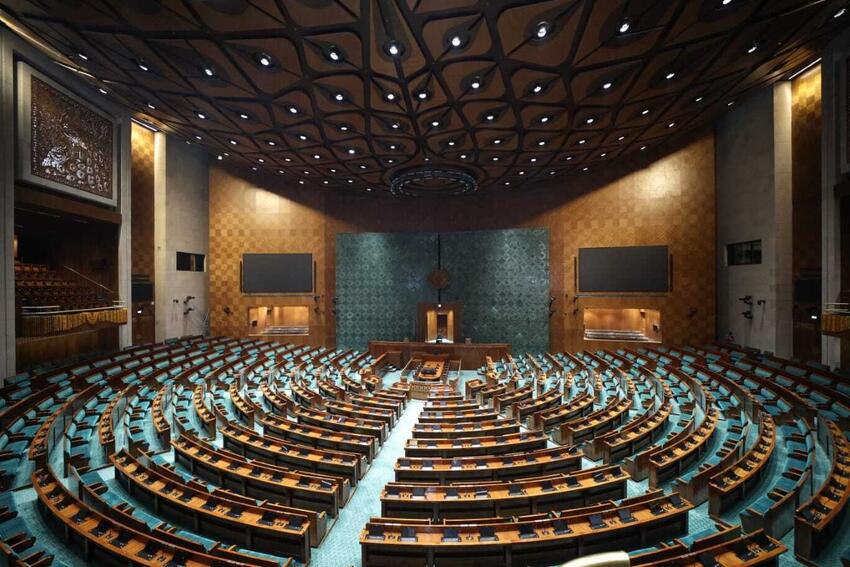
The new Parliament building in New Delhi, with its expanded halls, is ready. The question remains: will the rules that fill those halls reflect the wisdom of a diverse federation, or the simple arithmetic of a divided one?
Sudhir S. Raval is Consulting Editor at the ITV Network
